Three Days. Ten Projects. For a Better Open Web.
The ninth edition of the CloudFest Hackathon has come to a close — and what an edition it was. Once again, the extraordinary Hotel Krønasår at Europa-Park served as the beating heart of open-source innovation for three full, intensive days leading up to CloudFest 2026. From March 20-22, 101 dedicated hackers from 20 countries converged with a single shared mission: to build a more accessible, secure, and inclusive open web — one line of code at a time.
With 10 open-source projects, 18 passionate project leads, and over 2,500 human-hours of hacking, #CFHack2026 delivered on every front. The energy was electric, yet relaxed, the collaboration was genuine, and the results were extraordinary. And for the ninth consecutive year, the CloudFest Hackathon proved that when talented, purpose-driven people unite around shared challenges, remarkable things happen.

CloudFest Hackathon 2026 in Numbers
12 Partners & 4 Media Partners
Their unwavering support was instrumental in bringing our vision to life and amplifying our
community’s message far beyond Europa-Park.
10 Projects
Showcasing the diversity and creativity of our participants across a wide array of
technologies, CMS, and real-world challenges.
101 Attendees from 20 Countries
Bringing a rich mosaic of cultures, ideas, skillsets, and perspectives to every table in the
Krønasår.
18 Project Leads
Visionary contributors who pitched and shaped each project together with our project mentors from initial concept to a clear vision.
2500+ “Human” Hours of Hacking
Demonstrating the dedication and hard work poured into developing open-source solutions across three intensive days
€6000 Raised for Groundbreaker
Our collective contribution to the future of tech through education.
Nine Editions In. The Fire Still Burns.
There’s a moment, early on the first morning, when you can feel a shift. The introductions are still warm, the coffee is hot, attendees are excited, energized, or exhausted from the preceding chaos of 100+ people trying to decide on and find the right table to start contributing, and then — almost all at once — the room changes. Heads go down. Screens light up. Someone draws the first diagram on a whiteboard, and someone else immediately disagrees with it. That’s the CloudFest Hackathon finding its pulse, and at #CFHack2026, it happened faster than ever.
AI-assisted development visibly raised the pace of progress across projects — teams were reaching milestones much earlier in the weekend than in previous editions, leading to project mentors offering teams dedicated brainstorming sessions already at the beginning of day two to define stretch goals.
This year’s projects tackled challenges that matter beyond the hackathon bubble — accessibility, privacy, sustainability, documentation, and self-sovereignty. The best ideas didn’t come from the most experienced people in the room. They came from the friction between different perspectives, different stacks, and different ways of seeing the same problem. That friction is the feature, not the bug.
Almost zero no-shows — for an event that asks people to take days off work, book flights, and commit to something genuinely hard. That number is not a given. It is earned, every single year, by building something worth showing up for.


Hotel Krønasår: Our Home for Innovation
There’s something quietly rebellious about writing code for the future web inside a building that looks like it belongs to the past. The Hotel Krønasår doesn’t feel like a conference venue. It feels like a place where someone once mapped uncharted coastlines, catalogued unknown species, and came back with more questions than answers. For the second year running, it was our beloved hackathon venue.
If anything, the setting served as a quiet reminder of what the hackathon is actually about: showing up somewhere unfamiliar, with people you just met, and creating something new that didn’t exist before.
The Krønasår holds the energy well. Its spaces invite both the deep, solitary focus of someone in the zone and the loud, collaborative chaos of a team that just cracked something open. That balance is harder to find than it sounds, and we were lucky to have it again.

CloudFest Hackathon 2026 Project Results
Ten projects. Not ten ideas, not ten prototypes held together with good intentions — ten real, working, open-source projects built from the ground up in three days by people who, in many cases, had never met before Friday morning. 18 project leads brought the seeds; the teams brought everything else.
The range this year was striking. Privacy-first AI running entirely in the browser. A browser extension turning bot-optimised schema data into an accessibility tool. A documentation generator that will outlive the hackathon because its creator depends on it every day. A WordPress hosting control panel that declares war on the middleman tax. Each project came from a genuine problem, and each one leaves the hackathon as a genuine solution — not a slide deck, not a concept paper, but code you can run today.
Explore details for each project’s results either by clicking on the anchor links below or on the CloudFest Hackathon 2026 Projects page.
Want to see it all unfold in real time? The full results presentation from March 22 is on YouTube — all ten teams on stage and live demos, as they happened. It’s the best way to get a feel for the energy in the room and the quality of what was built in just three days!
▶️ Watch the CloudFest Hackathon 2026 Results Presentation
#CFHack2026 Awards
The awards at CloudFest Hackathon have never been about competition for its own sake. They exist because recognition matters, because sponsors who believe in the mission deserve to put their name on something meaningful, and because every euro raised through award sponsorships flows directly to the Groundbreaker Talents initiative — funding the next generation of technologists who may otherwise not get the chance.
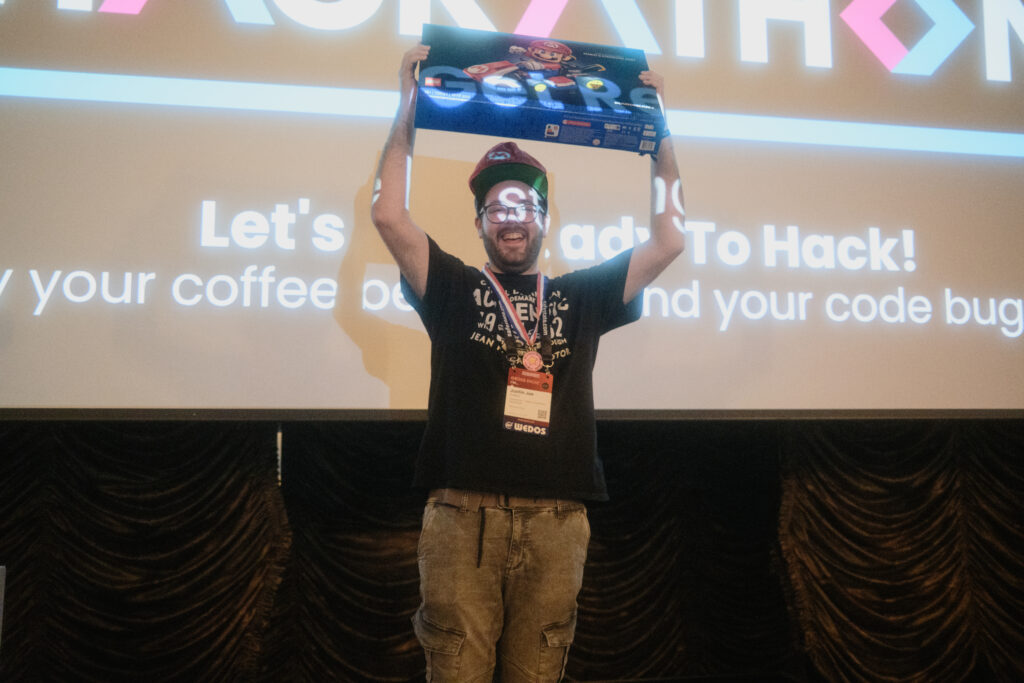
This year, the jury had a very hard time deciding on the winners, despite SWORD making it look easy — sweeping the Overall Winner, Dream Team, and Pitch Perfect Awards with a project that was as technically sharp as it was clearly useful.
The Universal Access Browser Extension earned its double recognition not through flash but through focus: a team that picked a real problem, stayed true to it, and delivered something that works for people who need it most.
Frugal AI rounded out the podium, and FAIR Package Management for TYPO3 generated more conversation online than any other project — which, for a topic as unsexy as package management, is its own kind of achievement.
Besides the CloudFest Hackathon project mentors, Lucas Radke, Alain Schlesser, and Simon Kraft, this year’s jury comprised partner representatives Thomas Maroschik (TYPO3), Milos Krasojevic (Supermicro), Devin Sears (Bluehost/Yoast), media partners Marco Keul (Hosttest) and Bob Dunn (Open Channels FM), and Groundbreaker Talents’ Dr. Claudia Bornemann.


And The Awards Go To…
 | #CFHack2026 OVERALL WINNER 🥇Self-Hosted WordPress Optimized Runtime on Docker (SWORD) | sponsored by | For the team that hacks its way to the top, emerging as the ultimate #CFHack Champion at the CloudFest Hackathon 2026. |
 | Tech Visionary Award 🥇Universal Access Browser Extension | sponsored by | Awarded to the team whose project demonstrates the most innovative technical implementation and creative use of technology. |
 | Dream Team Award 🥇Self-Hosted WordPress Optimized Runtime on Docker (SWORD) | sponsored by | For the team that demonstrates exceptional teamwork, collaboration, and communication throughout the hackathon. |
 | Social Media Master Award 🥇 FAIR Package Management for TYPO3 | sponsored by Marko Heijnen &  | Highlighting the team that creates the most buzz on social media during the hackathon. |
 | Pitch Perfect Award 🥇 Self-Hosted WordPress Optimized Runtime on Docker (SWORD) | co-sponsored by Andreas Biberacher &  | Rewarding the team that delivers the most compelling and engaging project presentation for all. |
 | Breaking Barriers Award 🥇 Universal Access Browser Extension | sponsored by | Rewards practical implementation of inclusive design principles while breaking down barriers for both development teams and end users |
Our Partnership with Groundbreaker Talents

Every award sponsored at the CloudFest Hackathon carries a second purpose. Behind the trophy and the applause is a scholarship for a real person, in a place where access to a career in software engineering is far from guaranteed. Groundbreaker Talents equips talented individuals with the skills needed to thrive in the digital landscape and contribute to building a more accessible and inclusive web for everyone: The program supports young women from financially constrained communities in Uganda to train intensively, build portfolios, gain industry exposure, and launch careers in tech.
While unique circumstances in Uganda following the recent presidential elections prevented us from hosting a Groundbreaker scholar at this year’s hackathon, we’re using this moment to strengthen our commitment for the future. In 2027, we’re hoping to welcome not one, but two talented women from the Groundbreaker Talents program.
Our partnership with Groundbreaker Talents has become a central thread in what the hackathon is and what it stands for. It’s the answer to the question of what we’re actually building toward — not just a better open web, but a more equitable industry that doesn’t keep leaving the same people out.


Join Us in Making a Difference
You don’t need to wait until next year’s Hackathon to contribute to this vision. Individual donations to Groundbreaker Talents can be made directly through their donation platform, and every contribution—regardless of size—helps build a more equitable tech ecosystem.
Learn more about Groundbreaker Talents, our continued partnership, and how you can support the project:
Beyond the Code: New Additions and Evening Adventures
#CFHack2026 wasn’t just three days of hard work. It was three days of community — and this year brought a handful of firsts alongside the beloved traditions that make the event what it is.
CFHack Buddies made their debut at this edition. A small group of experienced CFHack veterans volunteered to be paired with first-time attendees before and during the event, helping newcomers navigate everything from how teams form and how pitching works, to what to pack and what to expect on day one. It was a simple idea with an immediate impact — and the kind of thoughtful inclusion that makes this amazing community what it is. Thank you, Birgit, Jessica, Remkus, and Pascal for stepping up in this new role.
Another first: the AI Infrastructure Support table, powered by Supermicro and Nvidia. A proxy server published an Ollama endpoint directly onto the venue’s wifi, backed by powerful GPU servers running in Supermicro’s lab in the Netherlands. Attendees could request whichever open models they wanted to run, and the Supermicro team would spin them up on demand. Run by Milos Krasojevic, Pekka Leppänen and Juan Jose Gutierrez Amador, the table became a quiet hub of experimentation throughout the event. Pekka even got inspired enough to build a real-time dashboard monitoring server resources directly on the GPUs as a fun side-project of his own.
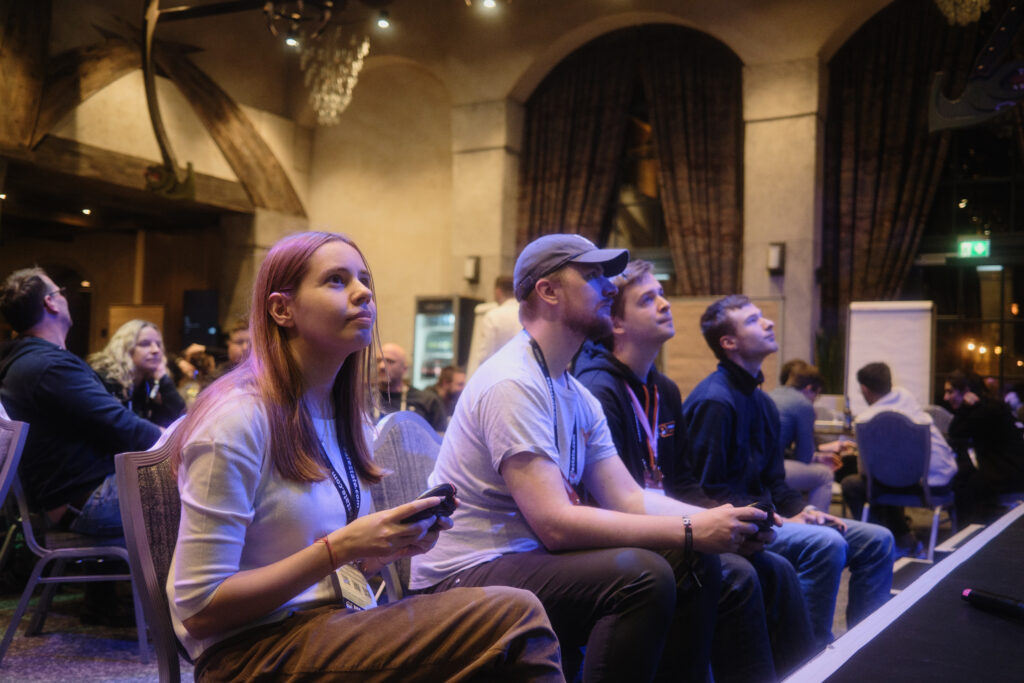
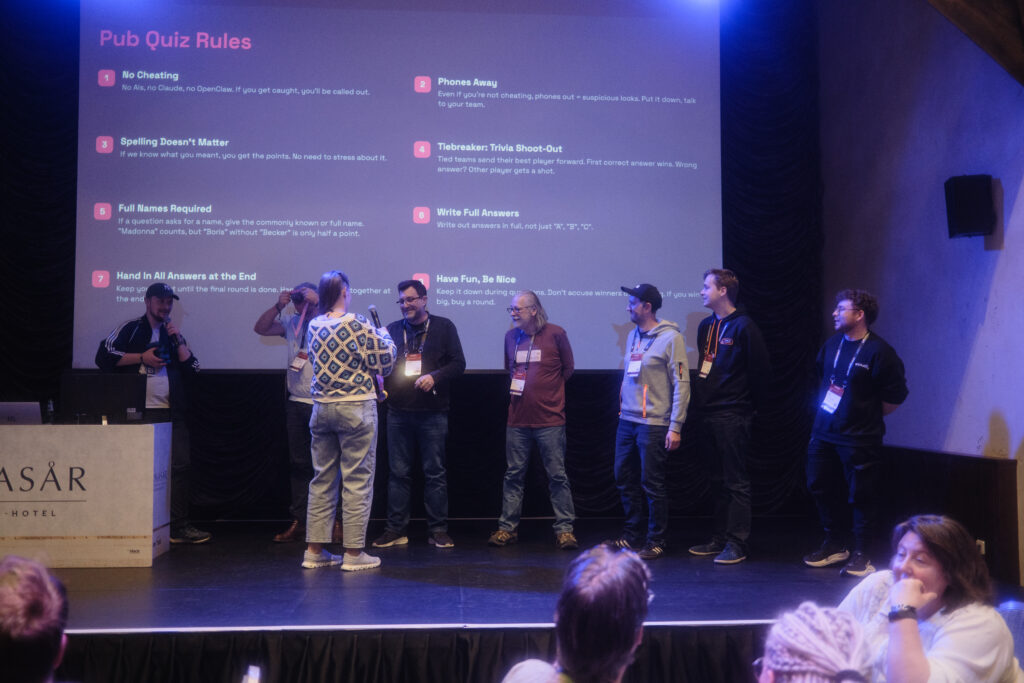
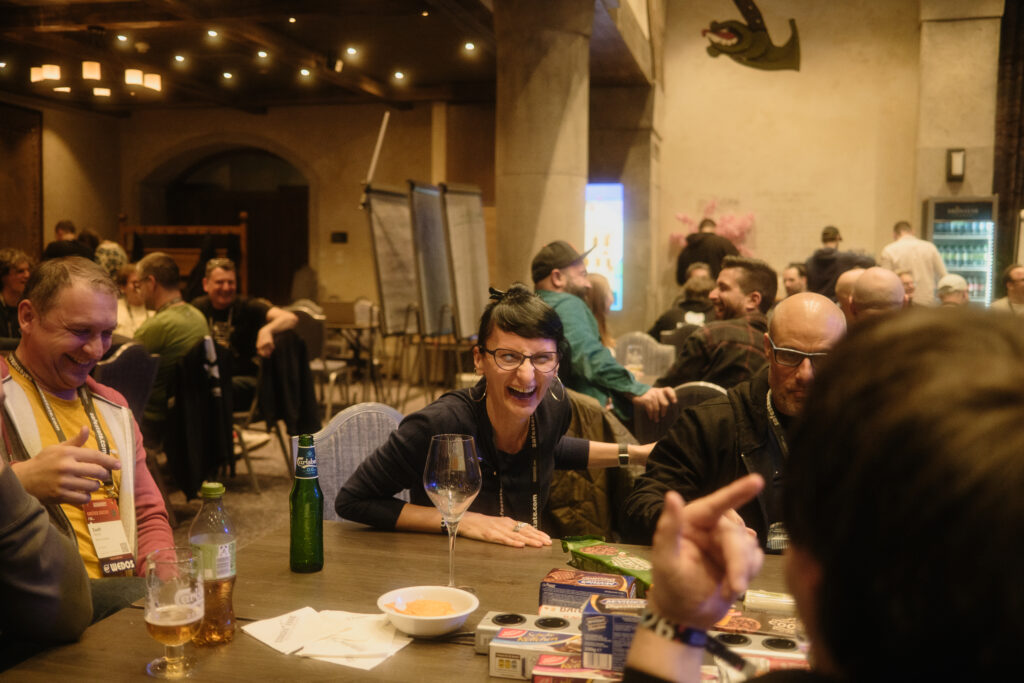
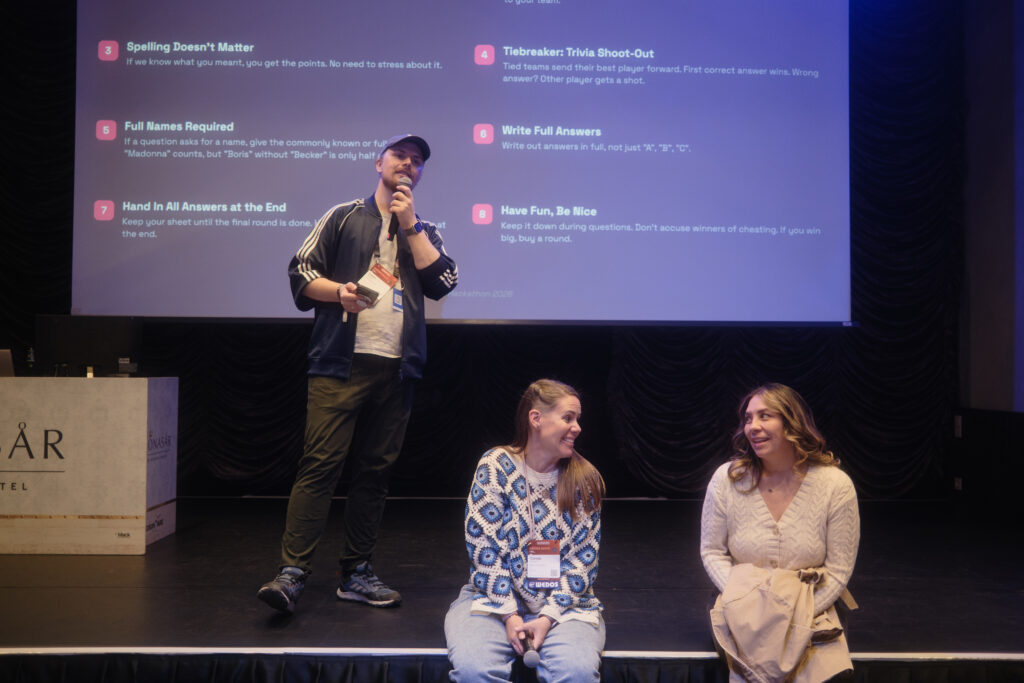
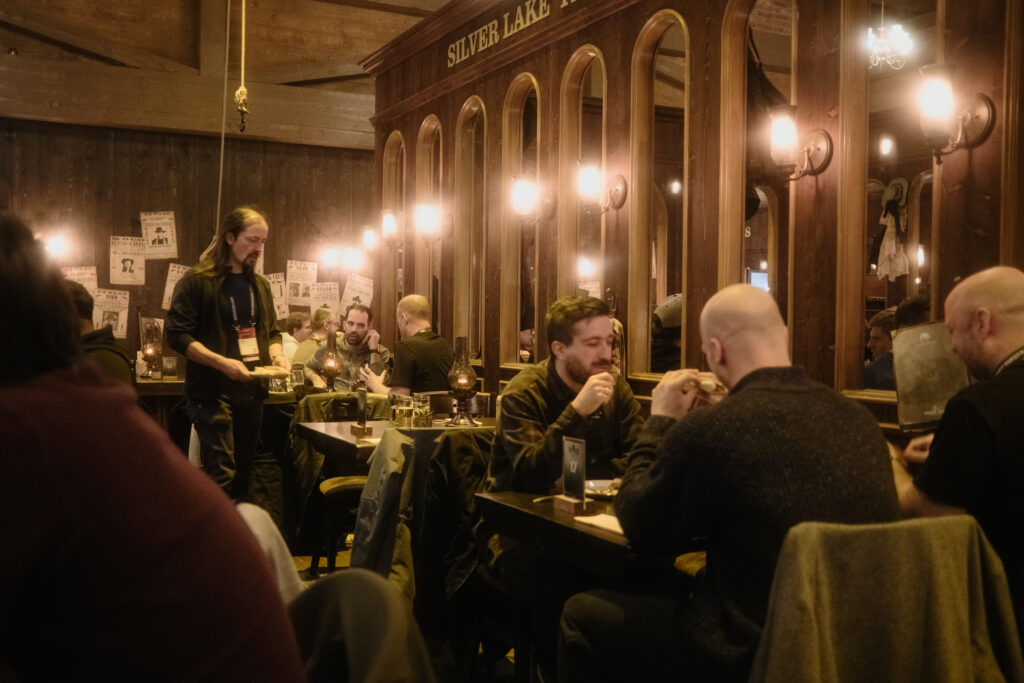
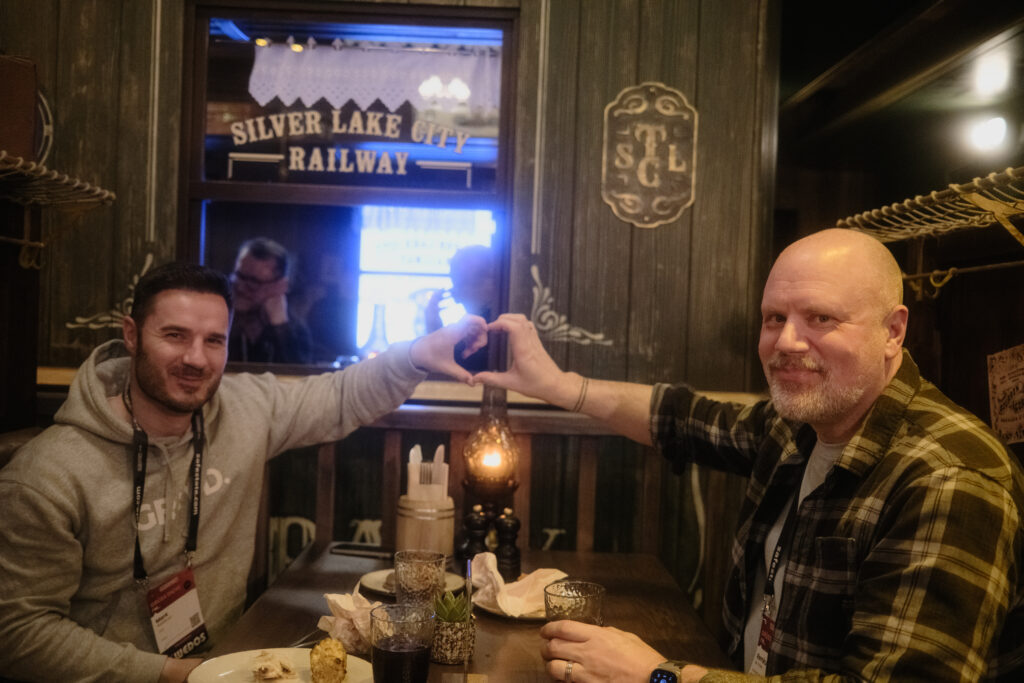
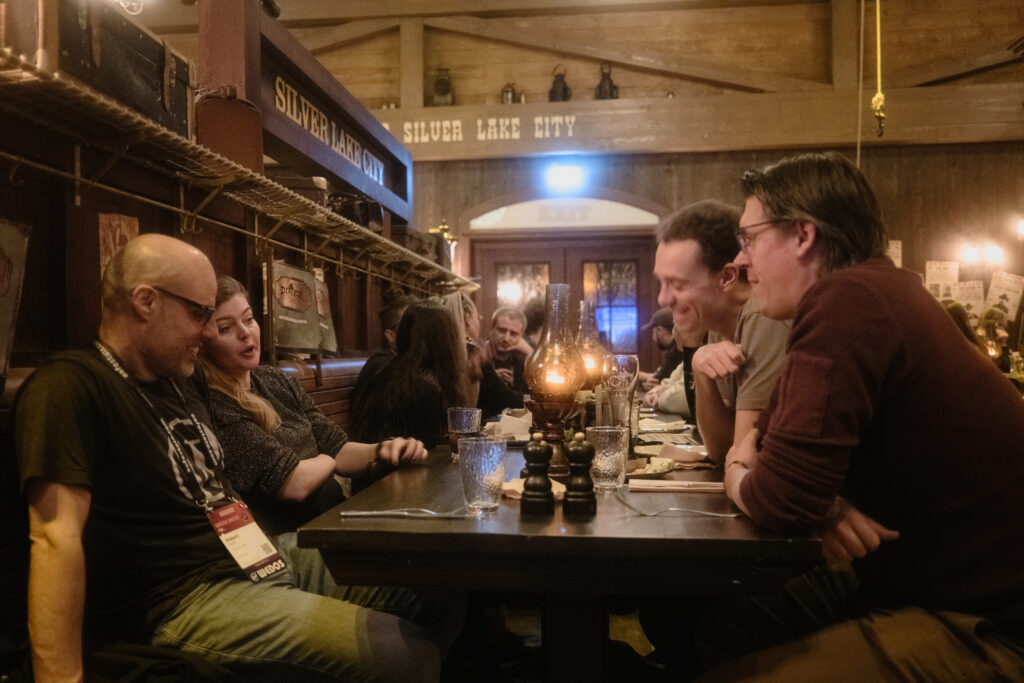
The evenings told their own story. A brand new Pub Quiz made its first appearance, unleashing the competitive instincts of people who had been channelling them into pull requests all day. The Mario Kart Tournament returned, as chaotic and fiercely contested as ever. And on one of the evenings, the entire group ventured into Europa-Park’s newest area — the Silver Lake City — for a buffet dinner at the Dinner Station and drinks at the Wild Horse Saloon Bar. It turned out that a Wild West setting is an entirely natural fit for a group of open-source developers who spend their days trying to tame the frontier of the web.
And quietly running in the background throughout all three days, project mentor Alain Schlesser maintained a Generative AI Art Experiment on a shared canvas — a new image produced every 60 seconds, shaped by environmental sensors, ambient sound, a webcam, and the event’s live social media activity. Attendees could submit their own code snippets to influence the output. It was part experiment, part ambient artwork, and a reminder that creativity and engineering are not as far apart as they sometimes seem.
Find out more about our AI Art Experiment:



Partner Spotlight: The Foundation of Our Success

None of this happens without partners who see the value in our event by directly investing in open-source work that benefits everyone, including their own ecosystems.
This year, our 12 partners went further than writing a cheque — they sent people and became actively involved. Their engineers, product managers, and community leads rolled up their sleeves and joined project teams, contributed code, provided AI infrastructure support and stayed up late alongside everyone else. That kind of participation changes the room.
Huge thanks to our CloudFest Hackathon 2026 Partners!
Visionary Partners:
TYPO3, Yoast, GoDaddy and Supermicro/NVIDIA
Catalyst Partners:
Progress Planner, CloudLinux, Hostinger and WP Engine
Innovator Partners:
Codeable, Crowd Favorite, GREYD and Microsoft
Our media partners — hosttest.de, Open Channels FM, The Repository, and Roan de Vries from Vulgar Productions made sure the work didn’t stay inside the walls of the Krønasår.
The Dream Team Behind CloudFest Hackathon
A hackathon at this scale doesn’t run itself. It runs because a small group of people spends months thinking through every detail, troubleshooting every problem before it becomes one, and showing up on the day ready to hold the whole thing together while making it look effortless.

From left to right: Alain Schlesser, Lucas Radke, Carole Olinger, and Simon Kraft
Carole Olinger has built the CloudFest Hackathon into what it is today — not just an event, but a community with a genuine identity and a genuine purpose. Her fingerprints are on every aspect of it, from the projects selected to the culture in the room.
Lucas Radke, Alain Schlesser, and Simon Kraft kept ten project teams on track across three intense days — mentoring without micromanaging, guiding without overriding, and somehow being in the right place at the right time whenever a team hit a wall. If the project results are the output, these three are a significant part of the input.
Media Partner Coverage, Podcasts, and Blog Posts
The Repository:
📝 CloudFest Hackathon 2026: A Record Year for Projects, a New Schedule, and an AI Art Experiment: An interview with Carole Olinger
📝 SWORD Wins CloudFest Hackathon 2026: Highlighting the #CFHack2026 winner project


HOSTtest
Video interview with Carole Olinger, Head of CloudFest Hackathon: Link
Several more video interviews will be published on the HOSTtest YouTube channel in the upcoming weeks.
📸 Vulgar Productions by Roan de Vries
Roan de Vries once more presents several amazing CloudFest Hackathon photo galleries that visually narrate the hackathon’s story, capturing the attendees’ intense work, joy, and camaraderie.


Attendee Coverage
📝 Milana Cap’s full recap: https://developerka.org/2026/03/30/cloudfest-hackathon-2026/
📝 Alena Hackradt’s recap: https://www.gesellschaft-zur-entwicklung-von-dingen.de/en/magazine/our-2026-hackathon-project-website-responsibility-scanner
📝 Christopher Kurth’s recap: https://christopherkurth.com/en/event/recap-cfhack2026/
📝 Taco Verdonschot’s LinkedIn recap: https://www.linkedin.com/feed/update/urn:li:activity:7441044546802774016/
📝 Wesley Stessen’s LinkedIn recap: https://www.linkedin.com/feed/update/urn:li:activity:7442189402874900480/
SWORD Special:
- 📹 Hackathon aftermovie (SWORD song)
- 📹 We came, we coded, we conquered
- 📹 Behind the scenes & re-watch the play
- 📹 Mock interview
- 📹 Time-lapse while working
- 📹 The SWORD march
What’s Next?
The repositories are live. The projects are real. And somewhere right now, a team member may be opening a pull request that wasn’t on the hackathon roadmap yet. CloudFest Hackathon 2026 is over. The work it started is not. Keep building — and tag #CFHack2026 when you ship something.
One more thing worth saying out loud: CloudFest Hackathon 2027 will be the 10th edition. Wow – a decade!
We started something that has grown into one of the most distinctive open-source community events in the world, and the tenth edition deserves to be something special. Start thinking about your project proposals.
To every person who participated and contributed to this year’s edition: thank you for making it worth showing up for!
See you in 2027 for Edition #10. 💜
Save The Dates!
Mark your calendars now for CloudFest 2027! Building on this year’s extraordinary success, we’re preparing an event that will push boundaries even further while maintaining the intimate, collaborative atmosphere that also makes our hackathon unique.
Mark Your Calendars For Next Year!
CloudFest March 15-18, 2027
CloudFest Hackathon March 12-14, 2027 (to be confirmed)
Europa-Park Rust, Germany
Extend Your CloudFest Experience to Miami, US
Can’t wait until next March to reconnect with the CloudFest community? Join us for CloudFest Americas in vibrant Miami!
CloudFest Americas: UNITING THE INTERNET INFRASTRUCTURE ECOSYSTEM THROUGH CLOUD, CULTURE & COMMUNITY
November 11-12, 2026 | Miami, Florida
CloudFest Americas is part of the CloudFest global event series and serves as the convergence point for the cloud ecosystem across the Americas, where the full value chain comes together to do business, collaborate, and celebrate the culture that powers the internet.
The Project Results in Detail
Here’s a closer look at each of the 10 projects that made #CFHack2026 such a success. All details can be found on the project’s individual pages on the CloudFest Hackathon website: Projects 2026
Self-Hosted WordPress Optimized Runtime on Docker (SWORD)
🏆 Overall Winner · Dream Team Award · Pitch Perfect Award 🏆

Managing WordPress at scale has long forced developers into an uncomfortable compromise: pay exorbitant fees for managed hosting, wrestle with manual VPS configuration, or accept a recurring middleman tax to SaaS control panels. SWORD cuts the middleman straight out of the equation.
A multinational team built a lightweight, high-performance open-source control panel to deploy and manage WordPress sites using Docker. It turns a raw Linux server into a high-performance WordPress hosting suite where every site gets its own isolated container — with zero monthly fees. Users own the code, host the panel, and control the data entirely.
What they built: A fully functional end-to-end MVP with automatic server provisioning, one-click site creation, automatic SSL via Let’s Encrypt, FastCGI static page caching, dedicated Redis object caching, automated backup and restore (BorgBackup), Cloudflare DNS management, and scalable infrastructure that runs on a single VPS or manages an entire fleet. Every stretch goal was hit.
The stack: Traefik for routing, MariaDB for databases, Ofelia for cron jobs, and Dockhand for container debugging. Each site runs an optimised Nginx/PHP/Redis stack, with public static pages loading in under 100ms.
The team’s commitment to the bit was total. At one point, they took to the stage in full knight roleplay, foam swords in hand — and the jury, apparently, was convinced. As project lead, Wesley Stessens put it afterwards: “We already felt like the dream team long before we received the award.”
What’s next: The team intends to continue active development, refine the codebase, improve cloud API integrations, and build out agency-level staging features. They’ve also issued a challenge to next year’s teams: they won’t give up the crown without a fight. They have SWORDs, after all.
Team Leads: Franco Lombardo, Wesley Stessens
Team: Elias Hackradt, Emile Vianney-Liaud, Florian Blaser, Jan-Willem Oostendorp, Ovidiu Linca, Matthias Kurz, Zsolt Revay-Giran
GitHub: github.com/SynioBE/SWORD
Video Demo: Watch on YouTube
CF Hackathon Project Page: hackathon.cloudfest.com/project/sword
Universal Access Browser Extension
🏆 2nd Place · Tech Visionary Award · Breaking Barriers Award 🏆

In a web where website owners invest heavily in presenting structured content to bots and crawlers but give far less thought to users with disabilities, this team flipped the script. Their Chrome extension takes advantage of websites’ existing structured schema data to display relevant information in an accessible, efficient way — and layers in cutting-edge natural language technology to allow conversational navigation.
What they built: A browser extension with three core capabilities: a focused reading mode for pages with article, product, or recipe schema.org entities (with presets for low vision and dyslexia users); accessible central navigation for shop pages via schema maps; and a conversational interface powered by Microsoft’s NLWeb technology, allowing users to ask natural language questions about any supported website.
What’s next: Bringing the extension to production quality, expanding supported schema entities to events and locations, and building versions for Edge and Firefox.
Team Lead: Leonidas Milosis (Yoast)
Team: Elisa Foltyn, Lorenz Sigrist, Maja Benke, Milan Ferus-Comelo, Rolf Siebers, Tom Ottjes
GitHub: github.com/Universal-Access/browser-extension
Instagram: @universal_access_extension
CF Hackathon project page: https://hackathon.cloudfest.com/project/universal-access-browser-extension/
Frugal AI: The Green Model Router
🏆 3rd Place 🏆

Not every AI query needs a frontier model — and Frugal AI makes that argument in code. The team tackled one of the most quietly pressing challenges in AI today: how to use large language models more efficiently without sacrificing quality. Their routing proxy analyses incoming tasks, estimates their complexity, and directs them to the most suitable model rather than defaulting to the largest one available. The sustainability angle is built in from the ground up: smarter routing means lower energy consumption, reduced computational overhead, and more responsible use of AI infrastructure.
What they built: A modular proxy layer connecting different task assessment methods with different language models — from keyword search as a baseline through vector search, SVMs, BERT-based models, and LLM-driven techniques — allowing the team to evaluate how different approaches balance quality, speed, cost, and efficiency. A benchmarking layer and real-time dashboard make the environmental and cost impact visible. The modular design also serves as a strong foundation for future research into new routing strategies and model combinations.
What’s next: The research questions raised during the hackathon are already being explored further, with ongoing work building on the project’s architecture and early findings.
Team Leads: Jonas Liebschner & Ida Meier
Team: Tobias Winter, Eduard Marbach, Benjamin Burkhardt, Andreas Biberacher, Chandan Das Adhikari, Dmitry Rybakov, Fabian Genes, Julian Haupt, Leon Knauer, Michael Schmitz, Blanca Vitallowitz, Oliver Bartsch, Farzaneh Shams
GitHub: github.com/JonasLiebschner/Frugal-AI
CF Hackathon project page: https://hackathon.cloudfest.com/project/frugal-ai/
FAIR Package Management for TYPO3
🏆 Social Media Master Award 🏆

The TYPO3 ecosystem has long relied on a single centralized extension repository. This team set out to change that — exploring how FAIR-based (Federated and Independent Repositories) package management could create a more decentralized, transparent, and secure way of distributing TYPO3 extensions.
What they built: A comprehensive suite of tooling enabling TYPO3 to discover and install extensions from multiple sources, including existing repositories and FAIR aggregators. Key achievements included implementing TYPO3 client-side support for FAIR, building the FAIR Package Aggregator population pipeline, extending AspireCloud for TYPO3 taxonomies, extending TYPO3 Tailor for FAIR submission, adding TYPO3 support to FAIR Explorer, and launching fair.typo3.com — the second major instance of AspireCloud, giving TYPO3 its own federated package infrastructure. The team also created a Composer plugin for FAIR, added FAIR support to TYPO3 Core for the version 14 release, and launched an additional EU-based AspireCloud instance.
The team pressed well beyond their stated goals, completing a roadmap they had only partially envisioned before the hackathon. The ripple effects were immediate: within days of the event, developers from other open-source communities had already reached out about bringing FAIR to their own ecosystems.
What’s next: Production deployment of the hackathon’s core outputs is already underway, with further collaborative development between the TYPO3 and FAIR communities planned.
Team Leads: Benni Mack & Brent Toderash
Team: Filip Illic, Jochen Roth, Joost de Valk, Kai Grosz, Karim Marucchi, Oliver Hader, Taco Verdonschot, Sven Liebert
Deliverable: fair.typo3.com
Website: fair.pm
TYPO3 Extensions: extensions.typo3.org
CF Hackathon project page: https://hackathon.cloudfest.com/project/fair-package-management-for-typo3/
Doc2Me (formerly Block2Docs)

What started as Block2Docs — a proposal to reduce the manual toil of open-source documentation work — evolved over three days into something with a name that demands to be said out loud: Doc2Me.
The project was born from a very real frustration. Milana Cap, a documentation contributor at WordPress.org, found herself spending so much time on repetitive, structural documentation tasks that she had almost no time left for the actual writing. Her goal was simple: build a tool that handles everything boring, so documentarians can focus on what matters.
The team was small, and alignment on scope proved challenging — small misunderstandings early on rippled into bigger friction by day two. But curious minds prevailed. A last-minute prototype by one team member demonstrated the core concept in action, and the final morning became a flurry of refinement, reordering slides, and landing on that new name in a rather loud group chat moment.
What they built: A tool that parses code, reads configuration files and git diffs, and uses @tags from code comments to automatically generate code references for PHP and JavaScript, changelogs, and GitHub issues. It supports AI agent SKILLS for some tasks — but crucially, every feature works without AI too, keeping the tool fully open-source and free for anyone.
What’s next: What makes Doc2Me stand out is its longevity guarantee: it solves its own project lead’s real, daily problem, so it won’t be abandoned.
Team Lead: Milana Cap
Team: Wendie Huis in ‘t Veld, Mary J (JJ) Jay, Remkus de Vries, Johannes Bremer
GitHub: github.com/Doc2Me
Website (coming soon): doc-2.me
CF Hackathon project page: https://hackathon.cloudfest.com/project/block2docs/
WP Agentic Admin

What if WordPress had a fully local AI Site Reliability Engineer — one that never phones home, never sends your data to the cloud, and runs entirely in your browser? That was the challenge this eleven-member team set out to solve, and they delivered.
What they built: A WordPress admin plugin powered by WebGPU and WebLLM, running a Qwen 3 1.7B language model compiled to run on the user’s own GPU. Over three days, the team shipped 78 merged pull requests and tripled the plugin’s capabilities from 14 to 42+ abilities, covering plugin vulnerability scanning against CVE databases, database optimisation, content management, voice input (using a local Whisper model), and in-browser RAG with client-side vector embeddings. Full WCAG 2.2 AA compliance was achieved throughout.
Plugin Abilities Platform: The team’s most strategically significant contribution was a system allowing any third-party WordPress plugin to auto-register its own abilities with the AI assistant — turning WP Agentic Admin from a standalone tool into an extensible ecosystem, using WordPress’s native hook system.
What’s next: Proposing the WordPress Abilities API for WordPress core, expanding the Plugin Abilities Platform ecosystem, and supporting newer model architectures as WebLLM compilation support grows.
Team Lead: Marcel Schmitz
Team: Ivelina Dimova, Stefan Euchenhofer, Tome Pajkovski, Alexander Melde, Jan Vogt, Bowe Frankema, Robert Abela, Moritz Bappert, Mike Andreasen, Lúcio Sa
Website: bitpolar-tech.github.io/agentic-admin-for-wp-landing
GitHub: github.com/pluginslab/wp-agentic-admin
CF Hackathon project page: https://hackathon.cloudfest.com/project/wp-agentic-admin/
TestAlly for Developers

Automated accessibility tools catch roughly 30–40% of issues. The rest — keyboard navigation, screen reader behaviour, voice control compatibility — requires manual testing that most developers were never taught. TestAlly bridges that gap.
What they built: An AI-powered tool that takes HTML, CSS, and JavaScript as input alongside a one-sentence description of what the component should do, and returns a structured set of manual testing instructions for keyboard, screen reader, and voice control — or a clear all-clear. Every recommendation cites its source. The tool does not guess.
What’s next: A GitHub Action that posts test scenarios automatically on pull requests, and context detection so developers no longer need to describe the component manually. All contributions welcome — code, testing, documentation, and translation.
Team Leads: Anne-Mieke Bovelett, Nemanja Cimbaljevic, Steve Mosby
Team: Aaron Kessler, Giorgi Mamadashvili, Tammie Lister, Jessica Lyschik, Minas Vamvoukas, Mario Wolf, Tatiana Valachi, Farhan Ahmed, Zeshan Ahmed
Website: testally.io
GitHub: github.com/TestAlly-io
CF Hackathon project page: https://hackathon.cloudfest.com/project/testally-for-developers/
AI-Powered Plugin Builder for WordPress

8 people. 8 countries. One idea: make WordPress development accessible to everyone.
WordPress powers roughly 40% of the internet, yet building custom functionality on it still requires a developer. This team set out to eliminate that barrier entirely.
What they built: A tool that lets you describe what you want in plain language, directly inside the WordPress admin, and generates a working plugin within seconds — installed and ready to activate. No IDE, no file transfers, no external tools. The builder connects to AI models via WordPress 7.0’s new Connectors API, supporting Anthropic, OpenAI, and Gemini, and includes a prompt enhancement step to help users get better results regardless of how they phrase their request.
Most significant outcome: The Plugin Builder was contributed as a new experiment to the official WordPress AI plugin on WordPress.org — the same plugin maintained by the WordPress core team. As project lead, Marco Chiesi put it, this was an actual contribution to the WordPress AI roadmap, not a prototype sitting in an unvisited GitHub repository. Built on the bleeding edge of WordPress 7.0 beta, it is available now as a fork on GitHub and as a ready-to-install ZIP.
Team Lead: Marco Chiesi & Martynas Umbražiūnas
Team: Justin Joe Kostka, Katia Tsironi, Lada Makei, Monika Pucher, Pascal Birchler, Weston Ruter
Website: wpaipluginbuilder.org
GitHub: github.com/westonruter/wp-ai-experiments
CF Hackathon project page: https://hackathon.cloudfest.com/project/ai-powered-plugin-builder-for-wordpress/
Website Responsibility Scanner

Give the Website Responsibility Scanner a URL and it audits the site for accessibility problems and environmental impact simultaneously — returning a scored, actionable report that any site owner can act on, no WCAG expertise or carbon accounting knowledge required.
What they built: An open-source tool wiring together Google Lighthouse and axe-core for accessibility testing, the Green Web Foundation’s directory for sustainability checks, and CO2.js with the Sustainable Web Design Model v4 for carbon footprint estimation. Carbon calculations factor in the user’s country and grid intensity, breaking emissions down by data centres, networks, and end-user devices. Every piece of technical jargon is translated into plain-language guidance any non-technical user can act on. Results export as JSON, PDF, or shareable permanent links. Built on a Laravel API backend with a React frontend.
By the numbers: 154 commits, 50+ merged pull requests, and 12 production releases (roughly one every four hours) across two and a half days. Alongside the engineering, the team produced a full brand identity, personas and user stories, social media content, a podcast spot, a press release, and a demo video — a full product launch in a weekend.
What’s next: An accessibility audit of their own tool (a fitting priority for an accessibility scanner), simplified deployment, potential expansion into security checks, and deeper plain-language guidance.
Team Leads: Milian Hackradt, Alena Hackradt
Team: Maja Benke, Patrice Bender, Andreas Heigl, Christopher Kurth, Marius Perle, Maurice Müller, Stefan Schleyer, Ekaterina Streltsova GitHub: github.com/cfhack2026-wrs
Project recap: https://www.gesellschaft-zur-entwicklung-von-dingen.de/en/magazine/our-2026-hackathon-project-website-responsibility-scanner
CF Hackathon project page: https://hackathon.cloudfest.com/project/website-responsibility-scanner/
WP Plugin Insight

Anyone who has managed a WordPress site knows the problem: plugins get chosen based on download counts and star ratings, not on whether they’ll actually break your site. WP Plugin Insight tackles that directly — analysing plugin code at the static level to surface what the official directory doesn’t: actual PHP and WordPress version compatibility, deprecated function usage, internationalisation coverage, and outbound connection behaviour. The kind of information that actually matters when deciding whether a plugin belongs on a production site.
What they built: A distributed architecture from day one — analysis engine, backend API, frontend, and AI layer each living in separate repositories, developed in parallel. Connecting the pieces was the real challenge, and one that only fully clicked around the halfway mark on Saturday. From that point, it shifted from assembly to iteration: fixing edge cases, refining JSON output, and eliminating false positives. The moment the analysis engine started producing readable reports showing real PHP compatibility data rather than what a plugin self-declares was the turning point. By the final hours, someone had just gotten the AI module producing meaningful output. The laptops that were closed opened again. The initial dataset covers the full WordPress plugin repository — all 62,000 slugs — and the analysis pipeline runs automatically. The platform is live.
What’s next: The hosting ecosystem implications are significant. WP Plugin Insight has clear integration potential for automated vetting pipelines before plugins are allowed on managed hosting environments, compatibility checks tied to PHP version upgrades, and risk scoring for plugin audits at scale. The technical foundation is solid. The next step is deciding which direction to take it.
Team Leads: Marko Heijnen, Javier Casares
Team: Erik Torsner, Matthias Pfefferle, Ralf Wiechers, Marko Feldmann, Cyrille Coquard
Website: plugininsight.com
GitHub: github.com/wp-plugin-insights
CF Hackathon project page: https://hackathon.cloudfest.com/project/wp-plugin-insight/