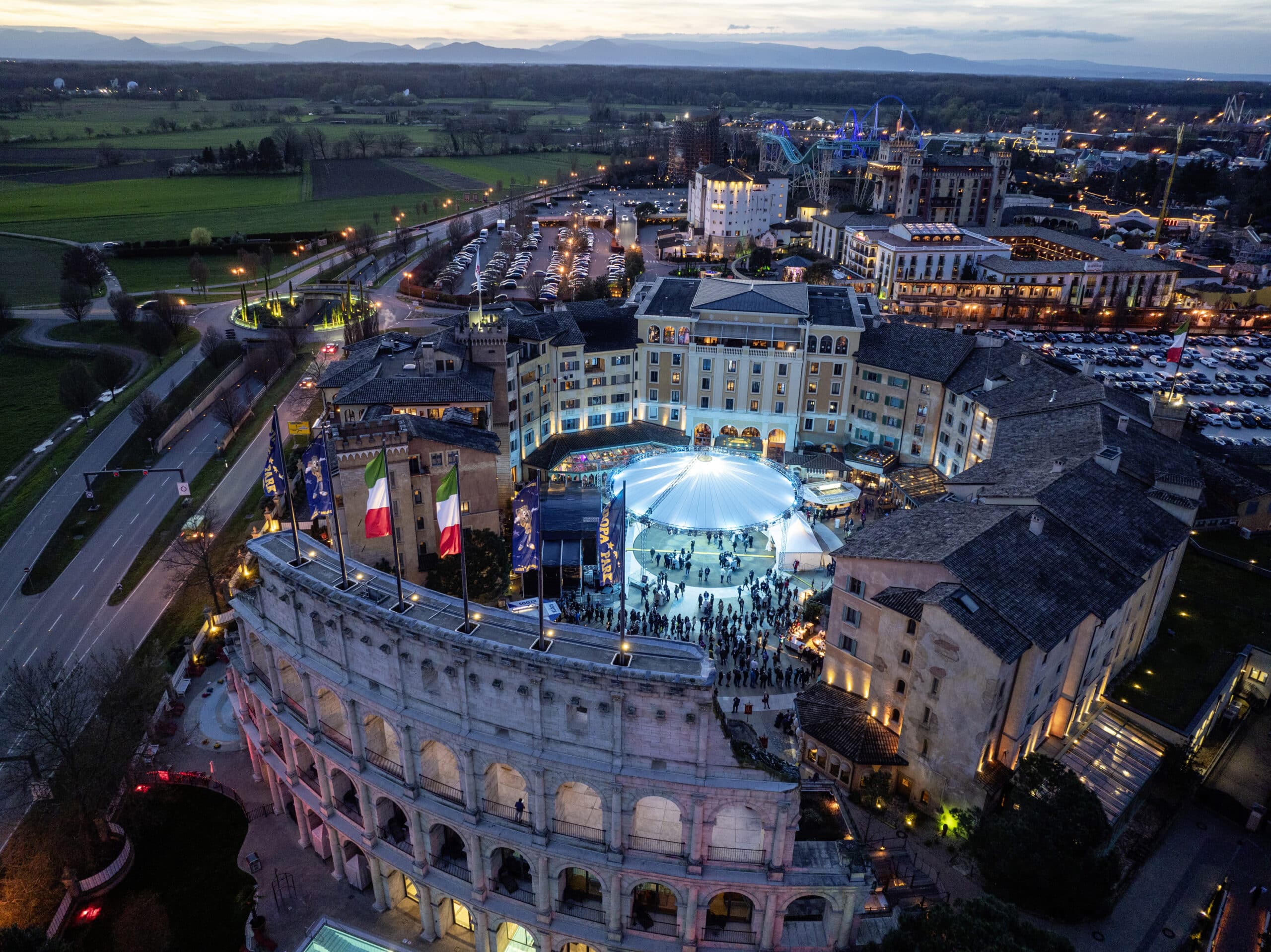

CloudFest 2026 chose the right theme at exactly the right time. “The Sustainability of Everything” was not framed as a narrow environmental slogan, but as a much harder question: can the internet industry build systems, businesses, and institutions that can actually last? CloudFest’s own framing made that clear from the outset, pushing the conversation beyond carbon and toward resilience, trust, AI, compliance, sovereignty, and the future viability of the internet itself.
Sustainable Growth, Responsible AI, and the Future of Digital Infrastructure
The most important session, appropriately, was the opening panel: “Sustainability is Everything Everywhere All at Once” bringing together Joost de Valk of Progress Planner, Christian Dawson of i2Coalition and Chief Evangelist at CloudFest Americas, Oliver Sild of Patchstack, Matt Russell, former Chief Cloud Officer at Namecheap, and Rachel Sterling, CMO of Identity Digital. Together they set the tone by refusing the easy version of the topic. Sustainability was not reduced to power usage or greener cooling. It was presented as a compound stress test: AI disruption, security overload, fragile open-source foundations, burnout, business-model instability, and a growing dependence on systems that many organizations barely understand. That is the real shift. Sustainability is no longer a side topic for ESG decks. It is now the central operating condition of digital infrastructure.
One of the strongest messages to emerge from the panel was brutally honest: AI is an amplifier, not a savior. It can increase speed, lower barriers, and create new value, but it also multiplies sloppiness, attack surface, dependency sprawl, and false confidence. The panel’s most useful insight was that the industry’s current obsession with “more with less” is itself unsustainable if quality, trust, and human judgment collapse underneath it. That is a theme CloudFest returned to repeatedly: automation without responsibility is not efficiency… it is deferred failure.
Trust Is Now Infrastructure: Governing Cloud and AI Under Pressure
David Cattler, drawing on his experience at NATO, inside the U.S. government, and now advising globally connected enterprises, framed the session “Trust is Now Infrastructure: Governing Cloud and AI Under Pressure.” That idea came through with particular force in one of the event’s most important strategic arguments: “trust is no longer a soft brand value,” Cattler stressed. Trust is becoming part of architecture itself. If cloud and AI are now treated by governments like strategic infrastructure, then compliance, jurisdiction, transparency, telemetry, and control cannot be bolted on later. They must be built in from the beginning. In other words, the next competitive advantage is not just performance. It is deployability under pressure.
That is a profound trend. The winners in the next phase of Cloud and AI will not simply be the fastest builders. They will be the ones who can operate across fragmented legal regimes, withstand scrutiny, and remain governable when conditions deteriorate. CloudFest’s official theme page pointed in exactly this direction by framing sustainability around resilience, security, trust, and the ability to build a future-proof internet.
Of course, the event did not ignore physical infrastructure. In “Paving the Way for Sustainable Data Center Operations,” Isao Yamamoto, Chief Specialist of the SSD Division at KIOXIA Corporation, grounded the theme in the hard engineering reality of the AI era: the performance curve is colliding with energy, bandwidth, and distance constraints. The talk’s focus on optical SSD architecture showed that sustainability at the hardware level is becoming a systems problem, not a marketing layer. In the AI age, greener infrastructure will not come from wishful thinking. It will come from redesigning the stack itself, from interconnects to cooling to workload placement.
Can AI Ever Be Green? Rethinking Efficiency in the Age of AI Factories
That same point was driven home even more directly in “Can AI Ever Be Green? How We Build the AI Factory Sustainably – From the GPU to the Power Meter,” presented by Christian Winterfeldt, Head of Datacenter DACH at Dell Technologies. Its message was sharp and timely: AI infrastructure cannot be run with old cloud-era habits. As data centers move toward town-scale power consumption, efficiency can no longer be measured by how many GPUs are deployed, but by how much useful output is generated per watt. The talk argued that AI facilities must be operated as tightly orchestrated “AI factories,” where power, cooling, storage, networking, racks, and software are designed together rather than treated as separate layers. It also made one of the event’s most important points: the real sustainability problem is often not hot GPUs, but idle ones. That shifts the conversation from brute-force expansion to smarter utilization, dynamic multi-tenant scheduling, full-stack telemetry, and software optimization through smaller models, quantization, caching, and better data pipelines. Even waste heat, in this view, stops being waste and becomes a resource. It was one of the clearest examples at CloudFest of sustainability as operational intelligence, not environmental theater.
Recent reporting on CNN and Fortune.com makes that point even harder to dismiss, because the external costs of AI infrastructure are no longer confined to the data hall. Emerging coverage around hyperscale facilities, drawing on a Cambridge-led study, suggests that large data centers may be creating localized “data heat island” effects, raising surrounding land temperatures by about 2°C on average, in some cases by far more, with impacts extending for miles into nearby communities. That reframes sustainability once again: not just as an internal question of efficiency or better hardware utilization, but as a public question of heat, land, water, and regional welfare; exactly the kind of broader systems pressure CloudFest placed at the center of the conversation.
The Human Side of Sustainability: Meeting Debt, Simplicity, and an Internet Everyone Can Understand
One of the most surprising aspects of sustainability is how organizations spend human energy: at first glance “Your Best Meeting Ever” may have seemed like an outlier, but it made a critical point: broken meetings are a form of organizational waste. Time, attention, focus, and decision quality are resources too. The session’s call to treat meetings like products, to eliminate “meeting debt,” and to measure return on time invested widened the sustainability conversation in exactly the right way. A company cannot claim to be future-ready if its people are drowning in rituals that produce friction instead of progress.
Then came the deeper civilizational layer of the theme. In “The Mother of the Internet“ featuring Radia Perlman, Fellow at Dell Technologies, in conversation with Jordan Yerman, Senior Copywriter and Content Lead at CloudFest, Perlman’s philosophy of simple, self-stabilizing, low-configuration systems—where creativity and science meet—reminded the audience that sustainable infrastructure is infrastructure that ordinary humans can live with. Complexity is not sophistication if it creates fragility. In “An Internet Everyone Can Understand,” with Ram Mohan, Chief Strategy Officer at Identity Digital, again joined by Jordan, another essential argument came into focus: language is infrastructure. If the future internet remains structurally English-first, it will exclude billions from full participation.
The Sustainability of Everything: Why the Internet Must Endure
To take us across the finish line with “The World’s Digital Memory,” Brewster Kahle, Founder and Digital Librarian at Internet Archive, joined Christian Dawson, Executive Director at i2Coalition, to push our theme even further: an internet is not sustainable if its memory is fragile, centralized, and permanently at risk of disappearing.
That may be the single biggest insight from CloudFest 2026: sustainability is about endurance. Can a system endure technically? Can a business endure economically? Can a platform endure politically? Can a community endure cognitively? Can knowledge endure culturally? Can the internet endure as something open, understandable, and worth trusting?
That is why this theme worked. It did not make sustainability smaller. It made it total.
CloudFest 2026 made the case that the future will not be won by those who optimize a single metric. It will be won by those who understand that energy, trust, governance, language, memory, attention, and public infrastructure are no longer separate conversations. They are one conversation now, and that conversation is the Sustainability of Everything.