

Every Cloud risk register has the usual suspects: ransomware, outages, and a hyperscaler quietly sunsetting a service you can’t live without. Very few have a line item for “honey trap.” And yet here we are.
Late last month, the New York Times reported that US intelligence agencies suspect an executive at a Singapore-based data center company of acting as a Chinese asset—and that surveillance of her revealed a close relationship with Nvidia CEO Jensen Huang. The share price has dropped sharply as rumors circulated and Huang wrote to his staff, apologizing for his conduct.
This was a shock that no one saw coming, and it’s a useful reminder that threats to this industry don’t always arrive through the firewall.
So, in the spirit of thinking the unthinkable, here are five other places trouble could come from.
1. There’s No Land for Data Centers
In 1811, English textile workers began smashing the machines they blamed for undercutting their wages and their craft. They called themselves Luddites, after the mythical “General Ludd”.
Today, the term ‘Luddite’ is commonly used to describe anyone who is anti-innovation, but many Luddites were skilled machinery operators themselves. They weren’t against tech; they were against the use of tech that was harmful to society.
Two centuries later, a new generation of ‘Luddites’ may be swapping hammers for ballots. Last week’s midterms handed Democrats both chambers of Congress, and data centers were literally on the ballot. There have been 41 local votes on data center moratoriums across the country, with voters on track to reject development in all but one. Redbud Consulting has done some neat analysis:

A majority of voters told exit pollsters that data centers were a crucial or major factor in how they voted. Not necessarily because of the tech, but because of the impact of the infrastructure projects on neighborhoods.
The community next door to your next site is a stakeholder, not a permitting hurdle, and it now has a very clear way of telling you so.
2. A Rock From Space
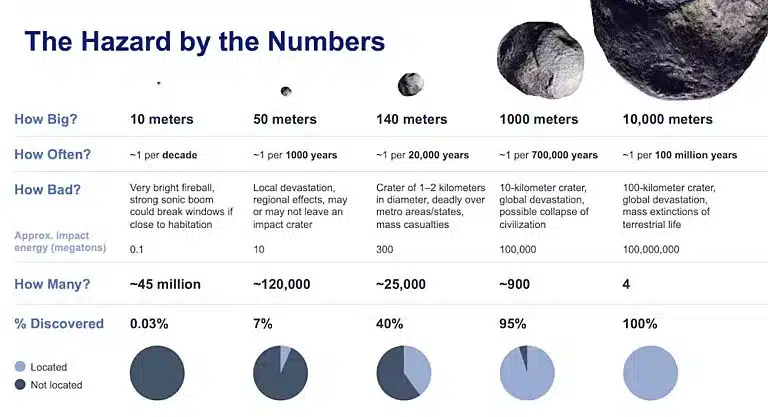
Your facility can survive floods, fires, and the occasional suicidal squirrel. A gigantic asteroid hurtling towards our planet is a tougher ask. The good news is that the odds are pretty small. The bad news is that “extinction-level event” is probably buried somewhere in your force majeure clause, and legal will want to talk about it.
3. The AI Decides It Doesn’t Need Us
We built all these data centers for AI—at least, where local communities allowed it. What happens when the AI decides it would like the internet all to itself? Picture a model that self-provisions, auto-scales into infinity, and issues invoices only it can read. On the plus side, your capacity planning would finally be someone else’s problem.
4. Your Chips Catch a Cold
Labs are already experimenting with computing on lab-grown neurons. The upside is staggering energy efficiency. The downside is that biological hardware can, in theory, get sick. Imagine a Patch Tuesday that ships with antibiotics, or a post-incident report co-authored by an epidemiologist. “Have you tried turning it off and on again?” takes on a darker tone.
5. The Great Unplugging
Vinyl came back. Film cameras came back. Flip phones are flirting with a comeback, and have never quite left Japan (shoutout to keitai users). What if logging off becomes the ultimate status symbol, and an entire generation decides the Cloud is deeply uncool? Wildly unlikely, of course. But a year ago, so was the idea of data centers swinging an election.
Bring Your Own Doomsday
Most of these will never happen. The point is that the risks that bite hardest are rarely the ones in the slide deck—they come from politics, people, and places nobody thought to look. That’s exactly the kind of conversation that happens in the hallways at CloudFest Global, March 15–18 at Europa-Park, where the people building the Cloud get together to talk/argue about what could break it.
Come and bring your favorite worst-case scenario, and discuss it over coffee or a beer with 10,000 of your new friends.
Registration is open, set up your CloudFest account to access a free Community Pass.